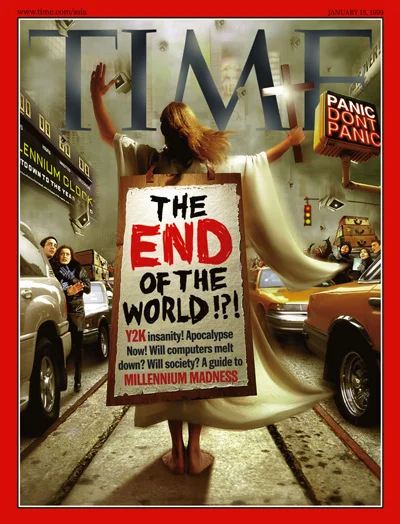
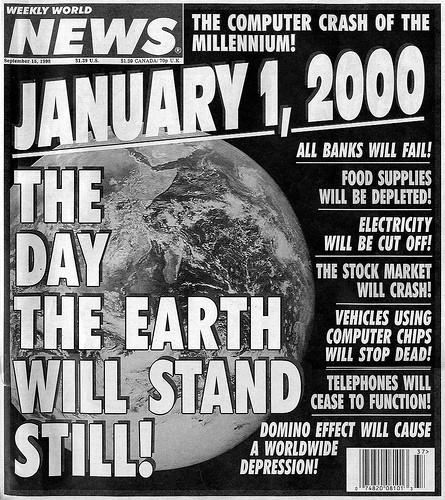
A variety of fringe groups and individuals such as those within some fundamentalist religious organizations, survivalists, cults, anti-social movements, self-sufficiency enthusiasts, communes and those attracted to conspiracy theories, embraced Y2K as a tool to engender fear and provide a form of evidence for their respective theories. End-of-the-world scenarios and apocalyptic themes were common in their communication.
Interest in the survivalist movement peaked in 1999 in its second wave for that decade, triggered by Y2K fears. In the time before extensive efforts were made to rewrite computer programming codes to mitigate the possible impacts, some writers such as Gary North, Ed Yourdon, James Howard Kunstler,[81] and Ed Yardeni anticipated widespread power outages, food and gasoline shortages, and other emergencies. North and others raised the alarm because they thought Y2K code fixes were not being made quickly enough. While a range of authors responded to this wave of concern, two of the most survival-focused texts to emerge were Boston on Y2K (1998) by Kenneth W. Royce, and Mike Oehler's The Hippy Survival Guide to Y2K.
Y2K was also exploited by some fundamentalist and charismatic Christian leaders throughout the Western world, particularly in North America and Australia. Their promotion of the perceived risks of Y2K was combined with end times thinking and apocalyptic prophecies in an attempt to influence followers.[82] The New York Times reported in late 1999, "The Rev. Jerry Falwell suggested that Y2K would be the confirmation of Christian prophecy — God's instrument to shake this nation, to humble this nation. The Y2K crisis might incite a worldwide revival that would lead to the rapture of the church. Along with many survivalists, Mr. Falwell advised stocking up on food and guns". Adherents in these movements were encouraged to engage in food hoarding, take lessons in self-sufficiency, and the more extreme elements planned for a total collapse of modern society. The Chicago Tribune reported that some large fundamentalist churches, motivated by Y2K, were the sites for flea market-like sales of paraphernalia designed to help people survive a social order crisis ranging from gold coins to wood-burning stoves. Betsy Hart, writing for the Deseret News, reported that a lot of the more extreme evangelicals used Y2K to promote a political agenda in which downfall of the government was a desired outcome in order to usher in Christ's reign. She also noted that, "the cold truth is that preaching chaos is profitable and calm doesn't sell many tapes or books". These types of fears and conspiracies were described dramatically by New Zealand-based Christian prophetic author and preacher Barry Smith in his publication, "I Spy with my Little Eye", where he dedicated a whole chapter to Y2K. Some expected, at times through so-called prophecies, that Y2K would be the beginning of a worldwide Christian revival.
It became clear in the aftermath that leaders of these fringe groups had used fears of apocalyptic outcomes to manipulate followers into dramatic scenes of mass repentance or renewed commitment to their groups, additional giving of funds and more overt commitment to their respective organizations or churches. The Baltimore Sun noted this in their article, "Apocalypse Now — Y2K spurs fears", where they reported the increased call for repentance in the populace in order to avoid God's wrath. Christian leader, Col Stringer, in his commentary has published, "Fear-creating writers sold over 45 million books citing every conceivable catastrophe from civil war, planes dropping from the sky to the end of the civilized world as we know it. Reputable preachers were advocating food storage and a "head for the caves" mentality. No banks failed, no planes crashed, no wars or civil war started. And yet not one of these prophets of doom has ever apologized for their scare-mongering tactics." Some prominent North American Christian ministries and leaders generated huge personal and corporate profits through sales of Y2K preparation kits, generators, survival guides, published prophecies and a wide range of other associated merchandise. Christian journalist, Rob Boston, has documented this in his article "False Prophets, Real Profits — Religious Right Leaders' Wild Predictions of Y2K Disaster Didn't Come True, But They Made Money Anyway".